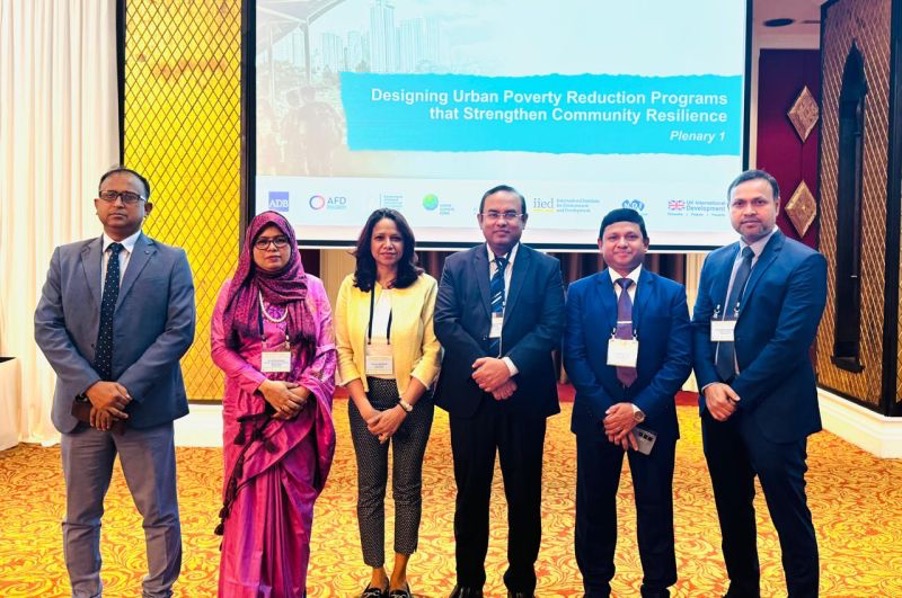

HSBC's Economic Outlook 2024 provided a comprehensive assessment of Bangladesh's macroeconomic trajectory and its positioning relative to South Asian peers. Quay Asia attended the briefing and distilled the key takeaways most relevant to our development practice and the organisations we work with.
Bangladesh vs South Asian Peers: A Mixed Scorecard
Bangladesh's economic growth story over the past decade has been remarkable - consistently outpacing many regional peers in GDP growth, poverty reduction, and human development indicators. However, the HSBC outlook highlighted areas where Bangladesh is falling behind, particularly in institutional quality, ease of doing business, and the diversification of its economic base.
While India and Vietnam have attracted significant foreign direct investment in technology, manufacturing, and services, Bangladesh remains heavily dependent on the garments sector for export earnings. This concentration creates vulnerability - both to demand shocks in key markets and to the competitive pressures that will intensify after LDC graduation.
The Globalisation of Services
One of the most striking findings in the HSBC outlook was the accelerating globalisation of services trade. Countries that have successfully diversified into IT services, business process outsourcing, and professional services have achieved higher-quality growth with better employment outcomes. India's IT services sector is the most prominent example, but Vietnam, the Philippines, and Sri Lanka have also made significant strides.
Bangladesh has the demographic raw material - a young, increasingly educated population - but has been slow to develop the ecosystem needed to compete in services exports. This includes reliable digital infrastructure, English language proficiency at scale, internationally recognised technical certifications, and a regulatory environment that supports remote and cross-border service delivery.
Remittance: Backbone with Vulnerabilities
Remittance remains the single most important source of foreign exchange for Bangladesh, exceeding export earnings from garments in some periods. The HSBC analysis highlighted both the resilience of remittance flows and their vulnerabilities - including dependence on a small number of destination countries, the informal channel challenge, and the risk of automation reducing demand for low-skilled migrant labour in Gulf states.
Strategies to protect and grow remittance income include diversifying destination countries, investing in skills development for higher-value migration, strengthening formal remittance channels through competitive exchange rates and digital platforms, and creating productive investment opportunities for returning migrants and their families.
Wage Competitiveness and the Middle-Income Trap
Bangladesh's competitive advantage in manufacturing has historically rested on low wages. However, as the economy grows and living costs rise, wage competitiveness is gradually eroding. The challenge is to increase productivity faster than wages rise - and to move up the value chain into activities that can sustain higher wages.
The middle-income trap - where countries lose their low-cost competitive advantage without developing the innovation capacity to compete on quality and technology - is a real risk for Bangladesh. Avoiding this trap requires sustained investment in education, research and development, infrastructure, and institutional quality. The HSBC analysis suggested that Bangladesh has perhaps a decade to make these investments before the window narrows significantly.
Women's Economic Empowerment and AI Implications
The outlook touched on two cross-cutting themes of particular relevance. First, women's economic empowerment remains both an opportunity and an imperative - Bangladesh's female labour force participation, while higher than some South Asian peers, has plateaued and could be unlocked further through targeted policy interventions.
Second, artificial intelligence and automation present both opportunities and threats. While AI could boost productivity and create new service export opportunities, it also risks displacing the low-skilled workers who currently drive Bangladesh's manufacturing and migration economies. Proactive policy responses - including reskilling programmes and social protection for displaced workers - are needed now, not after disruption occurs.
Revenue-to-GDP: The Fiscal Constraint
Perhaps the most fundamental constraint highlighted in the HSBC analysis is Bangladesh's persistently low revenue-to-GDP ratio - among the lowest in the world. Without adequate domestic revenue mobilisation, the government cannot finance the public investments in infrastructure, education, health, and social protection that are needed to sustain growth and avoid the middle-income trap. Tax reform is not merely a fiscal exercise - it is a prerequisite for the country's entire development ambition.